A Nail, a Price List and a Nod: The High Street’s Unlikely Art Dealers
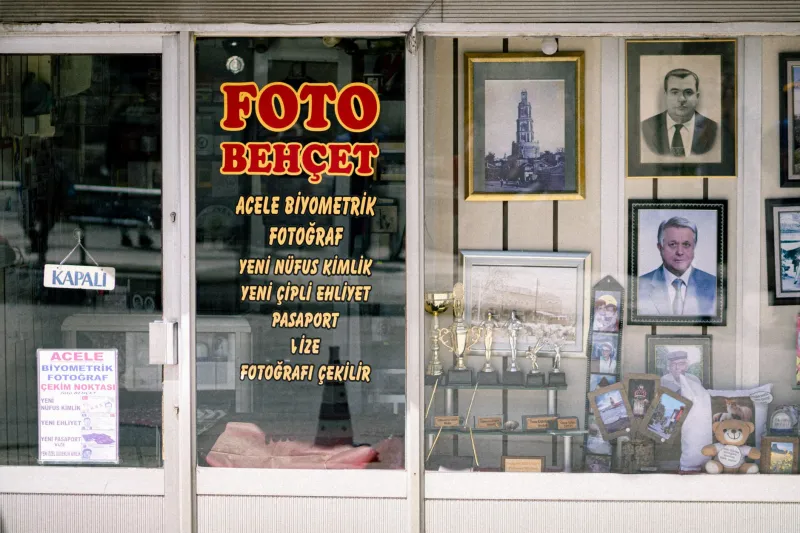
Walk into a certain barber’s on a side street in Leeds and you will find the usual: clippers, a radio stuck on a local station, a queue of men pretending not to mind waiting. You will also find a wall of photographs for sale. They are hung with the same pragmatic hardware as the mirror — a nail, a hook, a bit of wire — and beside them, taped to the till, is a handwritten price list. Nothing about it says gallery. That is precisely the point.
Across Britain, the high street has been quietly curating itself. Cafés, barbers, hardware shops, estate agents and the occasional launderette are giving over spare wall space to local artists and photographers. Sometimes there is a small commission. Often there is none. The work changes every few weeks or gathers dust for six months. There is no private view, no press release, no white cube. There is a nail, a price list and a nod.
The wall above the mirror
The idea is not new. Pubs have hung local paintings for decades, and the village hall exhibition is practically a British institution. What feels different in 2026 is the spread. The accidental gallery has moved from the pub’s back room to the shopfloor, and it is no longer a novelty. It is becoming part of how small businesses dress their walls.
In a Sheffield barber’s, the current show is a set of black-and-white prints of bus shelters at dusk. In a Bristol café, it is bright抽象? No — that is not right. Let us try again. In a Bristol café, it is bright abstract canvases by a regular who works nights at the hospital. In an estate agent’s window in Norwich, it is a rotating display of landscape photographs, each with a small card listing the price and the artist’s first name. None of these places would call itself a gallery. All of them are doing some of the work a gallery does.
No commission, no private view
For artists, the appeal is not simply exposure. Exposure is the word people use when they are not paying you. The real draw is directness. There is no submission fee, no selection panel, no invigilation rota. You ask the person who owns the wall. They say yes, or they say the wall is full until March. You turn up with a hammer and a friend.
Sales are modest. Nobody is quitting the day job because a watercolour sold above the chest freezer in a corner shop. But the transactions are real, and they happen without the theatre of a gallery. A customer asks who took the photograph. The barber says, ‘She lives round the corner.’ The customer buys it for forty pounds. The barber takes nothing. The artist gets forty pounds and a story. That is not a business model, exactly, but it is a circuit.
There is also a freedom in showing work where nobody expects it. A formal gallery asks you to be coherent, to have a statement, to make a show. A wall above a mirror asks only that the frames do not fall on anyone’s head. Artists can test things: a series of small prints, a single painting, a set of postcards. The stakes are low enough to be honest.
What the empty shopfront is for
The high street has its own reasons for saying yes. A shop with pictures on the wall looks cared for. It looks like somebody is paying attention. In towns where every other doorway is boarded or plastered with letting signs, that matters. Art does not fill a vacant unit, but it can soften the edges of one. Some landlords have allowed artists to use empty windows temporarily; others have found that a local exhibition draws more glances than a ‘To Let’ board ever did.
It would be easy to romanticise this. Poor lighting is a real problem. Insurance is often an afterthought. A framed print in a café can be damaged by steam, sunlight or a careless coat. And not every shopkeeper wants to be a curator; some are simply being polite. But the arrangement persists because it is cheap and human. It does not require a strategy document. It requires a wall.
The audience that never goes to galleries
This is the part that interests me most. The people looking at these pictures are not necessarily gallery-goers. They are waiting for a haircut, buying a drill bit, asking about a flat. They might never choose to spend a Saturday in a white room with a laminated interpretation panel. But they will look at a photograph while their coffee cools. They will ask a question. They might even buy something.
That is not a lowering of standards. It is a widening of the door. Formal galleries do many things well: conservation, context, scholarship, the careful display of difficult work. The high-street wall does almost none of that. What it does is put art in the path of ordinary life, without a threshold. You do not have to know how to behave. You are already behaving: you are in a shop.
A different kind of curation
The person hanging the work is usually not a curator. They are a barber, a café owner, a hardware merchant. They choose what they like, or what a friend asked them to show, or what fits the space between the door and the fridge. The result is idiosyncratic. A wall might hold a moody landscape next to a cartoon of a dog. The labels are handwritten. The price list is taped up. It is not tasteful in the way a gallery is tasteful. It is alive in a way a gallery sometimes is not.
In 2026, when so much of the high street feels either corporate or closed, these small displays are a reminder that curation does not have to be official. It can be a favour. It can be a nail. It can be a price list by the till, written in biro, with one entry crossed out and corrected because the artist changed their mind.
That is not the whole answer to empty shops or arts funding. Nobody is suggesting it is. But it is a quiet, useful thing: a way for artists to be seen, for streets to feel less bare and for people to meet work they did not know they were looking for. The barber has a gallery wall now. It is not perfect. It is open.