The Lamp That Came Back: A Saturday Inside Britain’s Repair Cafés
On a grey Saturday morning in November 2026, the queue outside a church annexe in south London is not for a jumble sale or a vaccination clinic. It is for a toaster. Behind it stands a woman with a table lamp under one arm and a carrier bag of flex in the other; behind her, a teenager holds a radio that emits one last, theatrical crackle when switched on. At the door, a volunteer with a clipboard asks the question that has become the movement’s gentle refrain: ‘What’s wrong with it?’
This is a repair café, and the scene is repeated across Britain, from library meeting rooms to scout huts and community centres. The premise is simple: bring broken things, sit with someone who knows their way around a screwdriver, and see what can be saved. There is tea. There is usually cake. There is no guarantee.
The waiting list is a guest list
Repair cafés have always been about more than thrift, but in 2026 the practical pull is hard to ignore. As the cost of living continues to press on household budgets, a session that might rescue a lamp, a kettle or a winter coat earns its place in the diary. Many cafés now run waiting lists. Some book out within minutes. The waiting list is not a bureaucratic nuisance; it is a cast list. A sewing machine, a hedge trimmer, a pair of boots, a child’s favourite toy: each item arrives with a story attached.
The trick is not to promise resurrection. Volunteers triage at a front table, checking cables, looking for scorch marks and asking whether the item has been used since it started making that noise. Electrical items are tested before and after. Safety is not an afterthought; it is the reason the room can be relaxed. Nobody wants a cheerful Saturday morning to end with a bang and a form to fill in.
Diagnosis is the drama
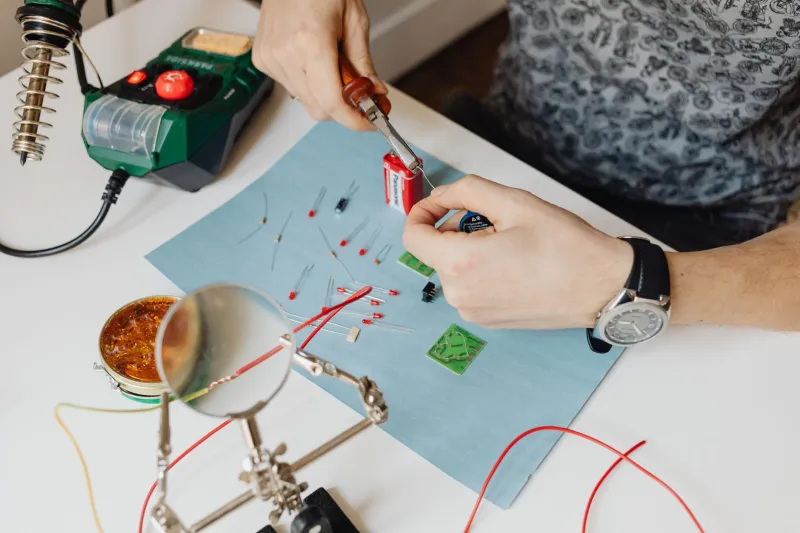
The theatre happens at the tables. A repair café is not a shop, and the volunteer is not a wizard. It is a process: unscrew, inspect, test, consult, try again. The audience is the owner, leaning in. Sometimes the fault is almost comic: a fuse, a clogged filter, a loose wire, a coin in a coin-operated toy. Sometimes it is a seized bearing or a cracked circuit board, and the conversation turns to parts, postage and whether the manufacturer still recognises the model.
The best moments are not triumphant fanfares but small admissions. ‘Ah,’ says the volunteer, ‘there it is.’ A lamp flickers back. A radio tunes in. A coat gets a patch that will not win a tailoring prize but will keep out the rain. The owner looks briefly surprised, as if a law of the universe had been suspended.
This is why repair cafés feel like optimism in practical form. They are not pretending that everything can be fixed, or that mending is always cheaper than buying. They are making a quieter argument: that objects are not disposable, that skill can be shared, and that a Saturday morning can produce something other than a receipt.
Tea, cake and the social contract
There is a social life to all this. People arrive with objects but stay for conversation. Retired engineers sit beside tailors, cyclists and parents. Younger volunteers bring YouTube tutorials and 3D-printed clips; older ones bring decades of instinct. Someone is always hovering by the tea urn, and the cake rota is treated with the seriousness it deserves.
For a country that likes to mourn the loss of the high street and the village hall, the repair café is a useful reminder that community does not always arrive fully formed. Sometimes it is assembled from folding tables, extension leads and a stack of old magazines. It is not nostalgic. It is happening now, in 2026, in rooms that smell faintly of solder and lemon drizzle.
There is also a quieter kind of dignity in the format. Nobody is means-tested. Nobody has to explain why they cannot afford a new toaster. Bring your broken thing, whatever your income, and the only currency is patience. That matters more than it might sound. Repair cafés are not charity shops with screwdrivers; they are a shared room where expertise is offered without condescension and received without embarrassment.
The limits of mending
It would be easy to overstate the movement. Repair cafés cannot fix the whole culture of waste. Some items are designed to resist repair: glued cases, proprietary screws, software locks, parts that cost more than a replacement. A volunteer can only do so much. Some sessions have to say no, and the honesty is part of the appeal. Nobody benefits from a false promise and a dangerous plug.
Even so, the café performs a kind of public education. It shows people how things work and why they fail. It makes repair visible, which is not nothing in a culture that usually hides it behind a returns label. It also creates a local record of what breaks, which is useful information for anyone who cares about right-to-repair rules, product standards and the steady accumulation of e-waste.
What gets fixed
At the end of a session, the tables are cleared and the clipboard is marked up. Some items go home working. Some go home with a diagnosis and a plan. A few go to the tip, but only after a proper conversation. The point is not to save every toaster. The point is to make throwing away a conscious act rather than an automatic one.
The woman with the lamp leaves with it glowing under her arm, though she stays for another cup of tea. The teenager’s radio still crackles, but now it also plays. The queue outside has thinned. Inside, someone is washing up mugs. A volunteer is explaining, for the third time that morning, why a fuse is not the same as a plug. It is not glamorous work. But it is the sort of work that makes a country feel a little less disposable.
In 2026, Britain’s repair cafés are not a niche hobby or a nostalgia trip. They are a quiet theatre of competence, held together by tea, patience and the belief that broken is not the same as finished. Bring out your broken. Someone will take a look.