The Ladder, the Choir and the Blown Fuse: Who Actually Switches On Britain’s Christmas Lights?
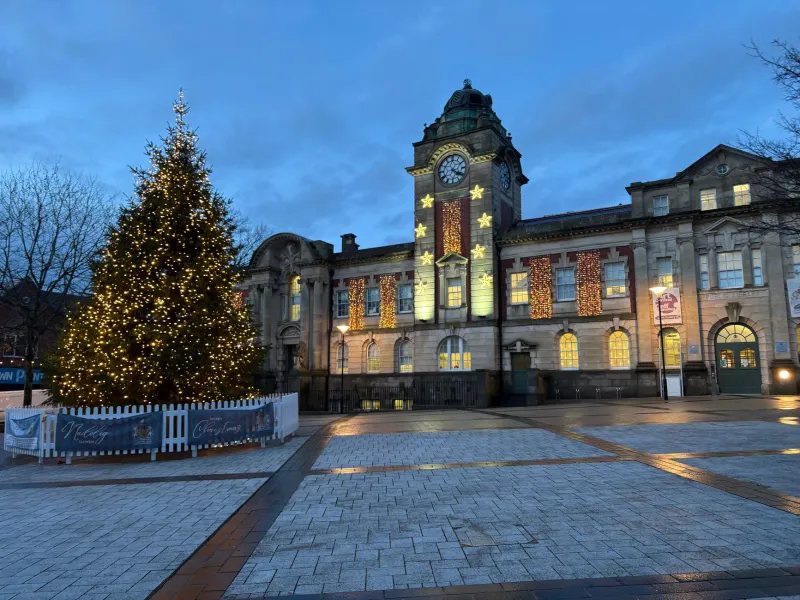
At ten past five on the first Friday of December, the high street is already dark in the way that only a British high street can be dark: three shops lit, one closing, a bus idling outside the estate agent’s. Then a man in a fleece appears with a ladder, a school choir arranges itself around a portable amp, and a town of about nine thousand people briefly becomes somewhere else entirely.
This is the switch-on. Not the celebrity kind, with a pop star and a branded countdown on a big screen, but the other kind — the one happening in several hundred places across the country on the same few weekends, organised by people who will be back at work on Monday. It is civic theatre performed with a risk assessment and a Tupperware box of mince pies, and it is one of the last genuinely free nights out left on the British calendar.
The committee meets upstairs at the pub
Every town has a version of this group. A town councillor, a couple of traders, a retired electrician, someone from the Rotary club, and a clerk with a folder. They meet in the back room of a pub in September, because that is when the council needs the paperwork and the storage unit needs booking. The budget is usually somewhere between four and fifteen thousand pounds, which sounds like a lot until you price a cherry picker.
Most of the decorations are kept in a lock-up behind the recycling centre, in labelled crates that smell faintly of old tinsel and WD-40. In September or October there is a testing day: every set of lights run up, every cracked plug noted, every figure checked to see whether the reindeer has finally lost its second eye. Portable appliance testing, insurance, ladder training, a conversation about whether the inflatable snowman counts as a structure. It is not glamorous. It is, in its way, extremely British.
The decorations are older than the children switching them on
A surprising number of high street displays are handmade, or at least hand-repaired. A local fabricator welds a frame; a signwriter repaints the sleigh; someone’s uncle rewires the star that has hung over the war memorial since the 1990s. Bulbs are bought in bulk from a wholesaler in the Black Country, and one box is always the wrong voltage.
What you see on the night — the slightly wonky Santa, the string of lights that stops halfway across the precinct — is the product of dozens of small decisions made by people who are not being paid to make them. The town’s display is not a design statement. It is a maintenance record.
The choir does the heavy lifting
The actual switch-on tends to follow a script. A brass band plays something from a film. The primary school choir sings two songs and one encore. A local vicar says a few words, a town crier reads a proclamation, and someone from the council thanks the sponsors, whose names are printed on a board near the war memorial in a font size that suggests they gave at least £250.
Then the countdown. Ten, nine, eight — and the moment works. It always works. For three seconds the high street is lit by something other than shop windows, and the crowd makes the noise a crowd makes when a thing has happened. Then someone near the front says, loudly, ‘Half of them haven’t come on,’ and everyone laughs, because that is also part of it. A fuse is located. A plug is wiggled. The rest of the lights come on to a small, entirely genuine cheer.
The economics of a modest spectacle
It would be easy to be sentimental about all this, and wrong. The lights exist in a difficult context: high streets with empty units, council budgets that have been trimmed for more than a decade, and the quiet sense that the retail rationale for a town centre has been eroding for years. In that context, the switch-on is not really a shopping event. The shops are mostly shut by six.
What it is instead is a claim on public space. A free, un-ticketed evening when the pavement becomes a stage and the person next to you is a neighbour rather than a customer. Some towns now crowdfund their displays, or sell sponsorship by the bulb. Others have handed the whole thing over to a business improvement district or a community trust. The model varies. The instinct — that the high street should be lit in December, whatever else is happening to it — does not.
What the lights are actually for
Britain has been lighting up its public spaces for a long time; Blackpool was illuminating its promenade in 1879, and the civic Christmas display became a fixture of postwar town centres. But the modern switch-on is less about spectacle than about continuity. It is the same night, the same songs, the same slightly faulty reindeer. That repetition is the point. In a country that has changed a great deal in twenty years, the modest high street display is one of the few things that still arrives on schedule and asks nothing of you but your presence.
It is also, if you stand at the back, quietly impressive. A few thousand pounds, a borrowed generator, a rota of volunteers, and a school choir in bobble hats. It shouldn’t add up to a night out. It does.
The quiet dismantling in January
By the second week of January, the ladders are back. The crates return to the lock-up. Someone writes a list of what needs replacing next year, and someone else says they’ll look at the reindeer’s eye in the spring, and they both know it will be September before anyone opens that crate again.
The high street goes back to being a high street. But for a few weeks it was briefly, stubbornly magnificent — not because the lights were good, but because a town had decided, again, to do it itself. That is the show. The switch is almost incidental.