Screws, Stubs and Stray Washers: An Inventory of the Nation’s Most Honest Drawer

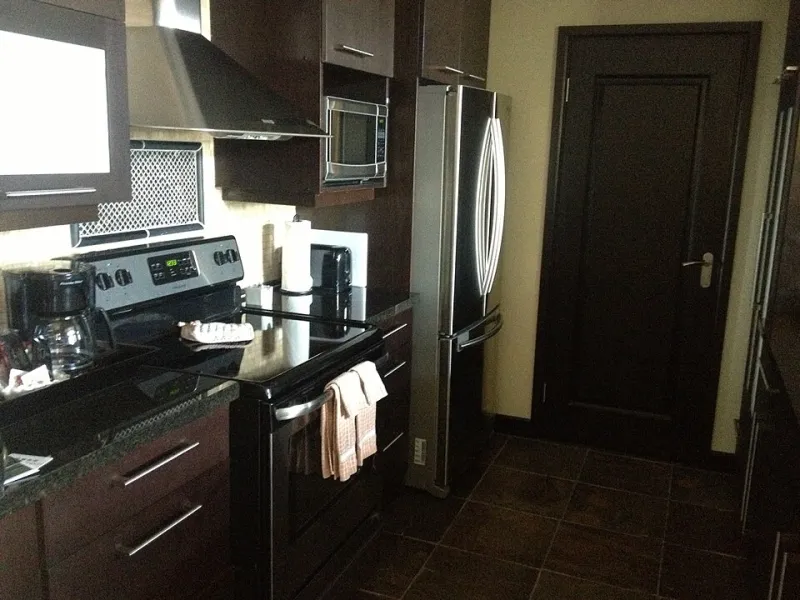
Photo: Dmitry Terekhov from Odintsovo, Russian Federation, CC BY-SA 2.0, via Wikimedia Commons
Every kitchen has a drawer that lies. Not the cutlery drawer, not the one with the good scissors and the birthday candles that are actually for cakes. The other one. The low, wide, slightly sticky drawer beside the oven, or the narrow one under the microwave, the one that opens with a small grunt and a smell of old rubber bands. Some households call it the miscellaneous drawer. Others, with a shrug, the man drawer. In my childhood home it was simply “the front drawer”, as if it had a formal role in local government.
It does not. And that is precisely the point.
In 2026, when every visible surface of the British home is quietly auditioning for a photograph, this drawer remains gloriously uncurated. It is the domestic equivalent of a browser with forty-seven tabs open: inefficient, yes, but somehow exactly how we think. It is also, if you look closely, a small museum of the national character.
The Drawer That Refuses to Be Defined
The kitchen junk drawer is not a failure of organisation. It is a category error. We keep trying to give it a job — batteries, perhaps, or takeaway menus — and it keeps accepting every job at once. It is the only drawer in the house that has no job description and therefore cannot be made redundant.
Open one and you will find a layer cake of contingency. On top: a takeaway menu from a restaurant that closed in 2019. Beneath it: a spare key that fits nothing in the current house, possibly nothing in the previous house either. Further down: a dead AA battery in a tiny resealable bag, waiting to be tested by a device that no longer exists. At the back: an Allen key from a flat-pack wardrobe that was dismantled during a house move and has since become abstract sculpture.
The drawer is not chaotic. It is sedimentary. Each layer marks a small domestic decision that was almost made and then postponed indefinitely.
A Small Museum of Contingency
There is a particular British optimism in keeping things “just in case”. It is not the optimism of the grand plan. It is the optimism of the half-used candle, the single chopstick, the length of string too short to be useful but too long to throw away. The drawer believes in a future that will require exactly this: a washer of unknown diameter, a fuse for an appliance you no longer own, a tiny screwdriver from a Christmas cracker.
Some of this is inherited. The post-war generation learned to make do and mend, and the drawer became a household insurance policy against scarcity. My grandmother had a drawer with three kinds of twine and a collection of buttons in a Quality Street tin. She could have repaired a small ship. We have inherited the instinct without the skills, which is why the drawer now contains mostly adapters.
But it is not only thrift. It is also a refusal to declare anything completely finished. The dead battery might come back. The key might fit a lock we have forgotten. The instruction leaflet for the boiler is still in there, even though the boiler was replaced three years ago, because throwing it away would feel like admitting that the old boiler — and by extension a small part of our former selves — is truly gone.
What’s Actually In There
A faithful inventory of the average British kitchen drawer, in no particular order:
- Foreign coins: a peseta, two francs, a coin with a hole in it, and something that might be a drachma.
- A spare key with a faded fob. No one knows what it opens.
- Birthday candles, some used, some snapped, all slightly melted at one end.
- A dead battery in its own small bag, labelled “test?” in handwriting no one recognises.
- The instruction leaflet for a kettle that was replaced in 2021.
- A single chopstick. Just the one.
- An Allen key, bent.
- A tape measure that retracts only if you ask nicely.
- A plaster in a torn paper wrapper.
- A tiny screwdriver from a Christmas cracker.
- Three screws of different sizes. None of them match. All of them might be important.
- A takeaway menu for a place that now sells something else entirely.
- A rubber band that has gone slightly sticky.
- A receipt for something small, in a currency you no longer use.
It is not a tip. It is a database with no search function.
The Design Argument Against the Perfect Cupboard
We live in an age of drawer dividers, labelled jars and the gentle tyranny of the tidy home. And there is nothing wrong with order. But the perfectly organised cupboard is a performance. It is the domestic equivalent of a LinkedIn profile: curated, aspirational, slightly exhausting. The junk drawer is the group chat.
Designers talk about “frictionless living”, but friction is where memory lives. The drawer forces you to rummage. It asks you to touch things, to remember, to make small judgments. It is not anti-design; it is post-optimisation. It acknowledges that life is not a system of neat categories. Life is a drawer full of screws and half a candle, and the best you can do is close it gently.
In 2026, as smart homes learn to anticipate our needs, the junk drawer remains stubbornly analogue. It cannot be automated. It cannot be integrated. It is a small act of resistance against the idea that everything can be improved. Sometimes the improvement is just a drawer that holds what you cannot yet decide to throw away.
The Drawer as a Portrait
What does the drawer say about Britain? That we are a nation of cautious pragmatists with a sentimental streak we prefer not to discuss. That we distrust waste and distrust perfection in equal measure. That we believe in repair, or at least in the possibility of repair, even if we never actually get round to it.
The drawer is also a portrait of a particular kind of hope. It is the hope that the future will be manageable — that the missing screw will turn up, that the spare key will find its lock, that the dead battery will prove to be alive after all. It is a small, daft, deeply human archive of things that might yet be needed.
So the next time you open that drawer and feel a flicker of shame, resist it. You are not disorganised. You are the curator of a very small, very honest museum. Close it gently. It has work to do.