The Corner That Works: How British Makers Are Building Serious Studios in Small Homes
The studio is closer than you think
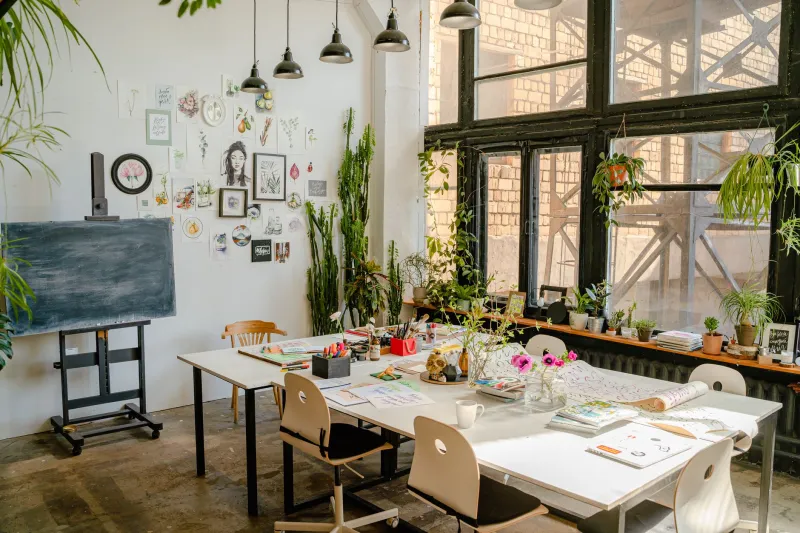
There is a certain British fantasy of the creative studio. It has north light, a kiln in the corner, a long bench, and no one asking where the dinner plates have gone. It is a lovely fantasy. It is also, for most people, not the reality. In 2026, the working studio for a great many illustrators, ceramicists, printmakers and makers is a corner of a spare room, a shed at the bottom of the garden, or a kitchen table that has been quietly colonised by a cutting mat and a mug of cold tea.
That is not a failure of ambition. It is a design brief.
Small-space making is not new. British creativity has always happened in modest rooms, allotment sheds and back bedrooms. What feels different this year is the confidence of it. Makers are no longer treating the kitchen table as a stopgap before the real studio arrives. They are designing for it: fold-away surfaces, stackable storage, drying racks that live behind the door, headphones for the noisy bits and a firm end-of-day routine that turns the workspace back into somewhere you can eat dinner.
What the constraints give you
Domestic constraints are not just obstacles. They are editing tools. A small space asks you to justify every object. You cannot keep every offcut, every failed glaze test, every roll of paper you might need one day. You learn what your work actually needs, and you learn it quickly.
The result is often work that knows its own scale. A3 instead of A1. A run of ten cups instead of a hundred. A zine instead of a monograph. That is not a lesser ambition. It is a different one, and it frequently produces stronger portfolio pieces because the work has to stand up close. When you are making at a kitchen table, you see the object at the distance a buyer or a reader will see it. There is no hiding behind scale.
There is also something quietly radical about letting domestic life into the work. The view from the window, the colour of the tiles, the rhythm of the household: these things seep in. A studio on an industrial estate can be beautifully neutral. A studio at home is never neutral, and that is part of its character.
Three habits that make a small studio work
- Zone by dust and sound. Keep clay, sanding and spray away from paper, keyboards and fabric. A tray, a cloth and a shelf can do more than a whole room. If you share the space, agree where the messy work stops.
- Store upwards, dry sideways. Wall hooks, tall shelves and folding tables are the quiet heroes of small-space making. Drying racks that fold flat are worth their weight in gold. So is a labelled box for the things you use once a month.
- Negotiate the timetable. A domestic studio is a shared studio, even when you are the only maker in it. Agree when the table is a desk and when it is a table. Put the work away at the end of the day, not because tidiness is a virtue, but because a visible mess makes it harder to start again tomorrow.
The portfolio begins at home
Portfolio pieces are often imagined as things made for a gallery, a client or a deadline. But the best ones frequently begin with something closer: a view from a window, a family story, a local street, a colour that keeps appearing in the kitchen. When your studio is in your home, those references are not distractions. They are the material.
With studio rents and travel costs still making themselves felt, the domestic studio has become a practical answer as well as a creative one. The garden shed has its own mythology in Britain, and rightly so. It is a room where nobody expects you to be social. The spare corner is less romantic, but it works. It keeps the work close to life, and it keeps life close to the work.
So if you are reading this at a kitchen table with a sketchbook under the fruit bowl, take heart. The corner that works is not a compromise. It is a studio with a life attached.